- There is a $75 non-refundable abstract submission fee per submission.
- The abstract submission fee is separate from the meeting registration fee.
- Abstracts may only be submitted after completing registration.
- Abstracts must be submitted with the intent to present.
- If the first author is unable to attend, it is their responsibility to designate a co-author to present on their behalf.
Abstract Submission Categories (Topics):
Please review the categories and descriptions carefully before submitting and select the one that best reflects the primary focus of your research during the submission process. Category descriptions are provided below for reference.
1. Analytical, Structural, and Glycotechnology Methods
Scope: Methods and technologies for glycan analysis, Mass spectrometry and structural characterization, imaging, single-cell/spatial glycomics, and platform development for glycomic profiling
2. AI, Informatics, and Computational Glycoscience
Scope: Computational and AI-driven approaches for glycan prediction, modeling, and analysis, including glycoinformatics and data integration.
3. Biomarkers, Diagnostics, and Precision Glycomedicine
Scope: Glycan-based biomarkers and diagnostic tools for disease detection, patient stratification, and precision medicine.
4. Cancer Glycobiology and Therapeutics
Scope: Glycans in tumor biology, immune evasion, and development of glycan-targeted cancer therapies.
5. Cardiovascular, Hematologic, and Metabolic Glycobiology
Scope: Glycan regulation of cardiovascular, blood, and metabolic processes, including hematopoiesis, thrombosis, bleeding, inflammation, and systemic disease.
6. Congenital Disorders of Glycosylation and Rare Diseases
Scope: Mechanisms, diagnosis, and treatment of inherited glycosylation disorders and related rare diseases.
7. Chemical Glycobiology and Carbohydrate Synthesis
Scope: Synthetic glycans, chemical tools, and mechanistic glycochemistry, including glycan mimetics and engineered structures.
8. Glycoengineering and Translational Therapeutics
Scope:Glycan editing, biologics, cell therapies, and drug development.
9. Glycoconjugate Biosynthesis and Degradation
Scope: Enzymatic pathways and cellular mechanisms governing glycan synthesis, processing, and turnover.
10. Host–Pathogen Interactions, Microbial and Infectious Diseases
Scope: Viral and microbial glycosylation, host–pathogen glycan interactions, including viral glycosylation and microbial glycobiology.
11. Immunology, Autoimmunity, and Glycoimmunology
Scope: Glycans in immune regulation, antibody function, and autoimmune or inflammatory diseases.
12. New Emerging Concepts in Glycobiology
Scope: Novel discoveries, conceptual advances, and interdisciplinary approaches expanding the boundaries of glycobiology.
13. Neuroglycobiology of brain development and disease
Scope: Brain-specific mechanisms, tools, and applications of glycobiology.
14. Systems and Integrative Glycobiology
Scope: Systems-level and multi-omic approaches, network biology, and systems-level understanding of
15. Proteoglycans, Glycosaminoglycans, and ECM Biology
Scope:Structure and function of proteoglycans and GAGs in signaling, extracellular matrix biology, tissue microenvironment regulation and disease.
16. Plant Glycobiology, Polysaccharides, and Applications
Scope: Plant glycans and polysaccharides, including biosynthesis, structure, and applications in biotechnology and materials science.
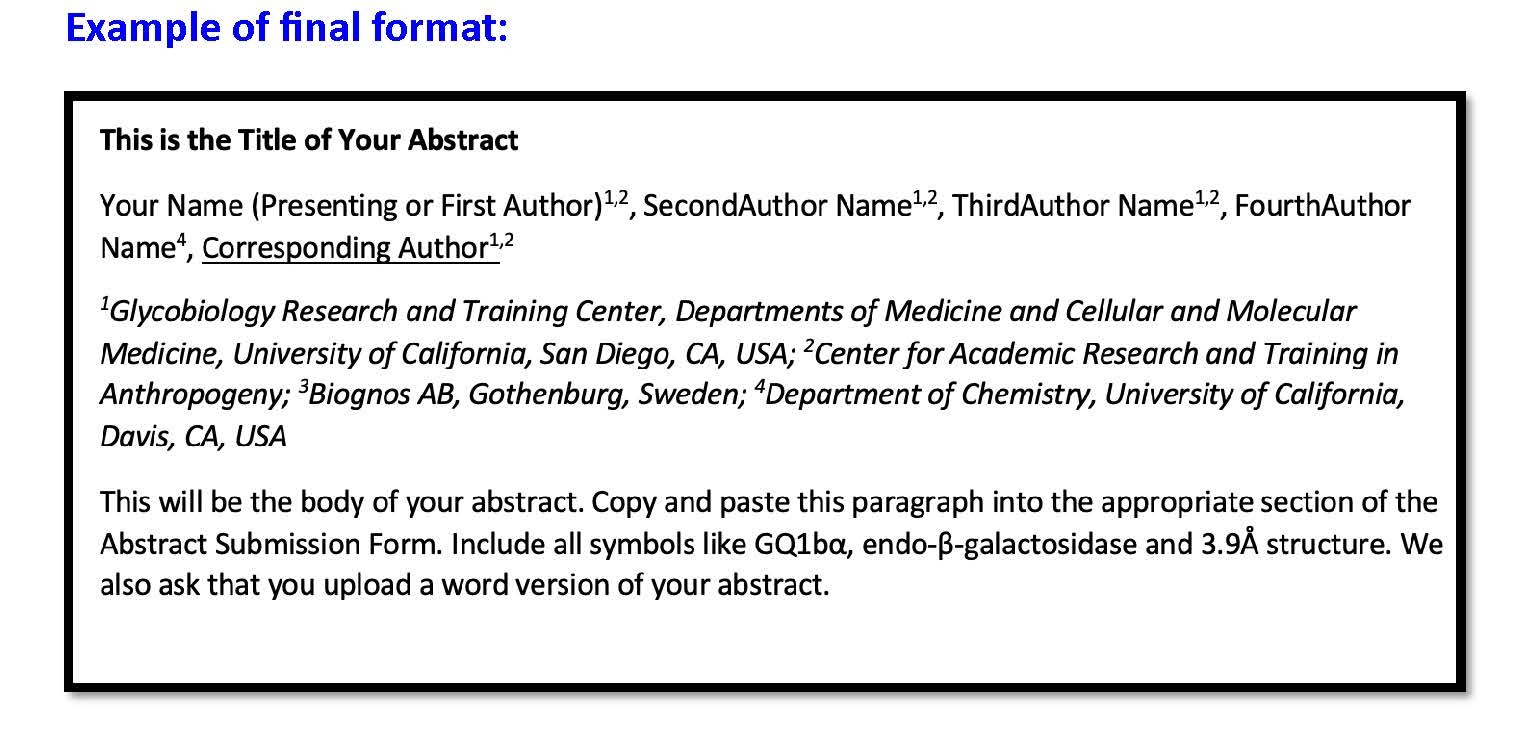
ABSTACT FORMAT GUIDLINES